Birth of Draupadi & Dhrishtadyumna
The Birth of Ghatotkacha
After escaping from the burning palace made of lac, the Pandavas and their mother Kunti left the town of Vanavrata. After crossing the Ganges, they moved south into a dense forest. Becoming tired, they stopped to take rest under a Banyan tree in that forest. Not far off from there, there lived a Rakshasa named Hidimva along with his sister (named Hidimva too) in a Sala tree.
Smelling human presence, Hidimva asks his sister to slaughter the Pandavas and bring them to him for a meal. His sister, reaches the Banyan tree with the goal of killing the Pandavas. There, she sees Bhima awake and keeping guard on his sleeping mother and brothers. The Rakshasa woman immediately falls in love with Bhima. She then assumes a human form (of a beautiful girl) and approaches Bhima. She tells Bhima about her brother's intention and expresses her love for him and asks him to elope so that she could save him from her brother. Bhima refuses and tells her that he is not afraid of any Rakshasa and will not leave his sleeping brothers and mother behind and elope with her.
Meanwhile, Hidimva, not seeing his sister return back with the humans, alights from the tree and walks towards the Pandavas. Seeing his sister in a human form he understands the situation. He gets angry and vows to kill her along with the Pandavas and engages in an altercation with his sister. Bhima, seeing this, stops the Rakshasa and asks him to engage in an encounter with him first. During their fight, the Pandavas and Kunti wake up and see this beautiful Rakshasa woman in human form. Kunti asks about her and she narrates the whole incident, and conveys her love for Bhima.
In the ensuing fight, Bhima kills Hidimva, and the Pandavas decide to leave the forest and go to a nearby town. As they start their journey, they observe that the Rakshasa woman following them. She addresses Kunti and Yudhishtir, tells them that she is in love with Bhima and would like to take him and be with him forever. In return she promises that she will return to them whenever they need her, and offers to carry all of them anywhere, anytime and to rescue them from any and all dangers. Yudhishtir agrees to that and lays a condition that Bhima should be returned to the Pandavas at night fall each day. Bhima then addresses the Rakshasa woman and says that he agrees to spend time with her, but only until she get a son.
Days pass by with the couple spending time in beautiful gardens and lakes and mountains. Finally, the Rakshasa woman, Hidimva, gives birth to a son. When the baby was born, he had a bald head like a Ghata (water-pot) and the parents named him Ghatotkacha (pot-headed). Ghatotkacha grew up to be a great bowman, extremely fond of the Pandavas and became their favorite.
Vaka Vada (The killing of demon Vaka)
After the birth of Ghatotkacha, the Pandavas are instructed by Vyasa to live in a town called Ekachakra in a Brahman's house, until he comes back for them. The Pandavas and their mother Kunti disguised as Brahmans, lead a simple life and depend on charity for thier living. The shared their alms at the end of the day dividing their collection into 2 parts, one for Bhima, and the other part equally divided between the others.
One day, Bhima and Kunti were alone in the Brahman's house and Kunti hears a loud wail from within the Brahman's quarters. Kunti tells Bhima that she doubts that the Brahman family who is hosting them is under some severe distress and that they should help them. Bhima requests his mother to find out their problem and promises that he will help relieve it, however difficult the task may be. Kunti approaches the inner quarters and sees the Brahman, his wife, son and daughter sitting together worried and crying. Kunti talks to them and inquires about their grief and says that she may be able to help them overcome their grief. The Brahman replies saying that no human being will be able to help them from their sorrow, and that their grief is because of a Rakshasa named Vaka who is a cannibal and serves as the ruler of the country. He had setup a system of turns through which each household had to provide him with a cart load of rice, 2 buffaloes and a human being who will carry these to his abode, who in turn will be devoured by the Rakshasa. He also adds that there lives a king in a city called vetrakiya, who is responsible for these territories, who has no idea of running a government and has no plans to make it safe for his subjects.
It is their turn now, and the Brahman has no way of turning anyone from his family to the Rakshasa. Hearing this Kunti offers one of her own sons since she has 5, and the Brahman has only one, who also is very young. The Brahman disagrees to take part in that, but Kunti convinces him that her sons all are endued with great power and energy and will definitely be able to defeat the Rakshasa.
Kunti also requests the Brahman not to disclose this to anyone else. The Brahman agrees to that and together with Kunti they approach Bhima. Kunti requests Bhima to accomplish this task and Bhima readily agrees. When the remaining brothers arrive in the evening, Yudhishtira learns about this and argues with his mother about her decision to send Bhima to the Rakshasa. Kunti convinces him and and says that by defeating the Rakshasa, they will be able to accomplish 2 things - return the favor to the Brahman (for giving them shelter in their house) and accomplish a high religious merit - which is obtained from a Kshatriya saving the life of a Brahman.
Bhima then leaves to meet the Rakshasa with the required food and buffaloes. After reaching the Rakshasa's abode, Bhima calls him by his name, and also starts eating the food that he had brought for the Rakshasa. The Rakshasa, seeing Bhima eating the food brought for him, advances angrily towards Bhima to kill him. Bhima returns a smile and continues to eat the food. Finally, they both get into a fierce fight. In the end, Bhima kills Vaka. Seeing this, the Rakshasa's relatives get scared and promise Bhima that they will never hurt human beings again. Bhima then drags the body of Vaka and places it in one of the gates of the town and silently returns back to the Brahman's house.
The next day, the people of the town see this and knowing it was that specific Brahman's turn, go to his house inquiring about this. The Brahman replies that there was another Brahman who offered to visit the Rakshasa in his place, and he should have accomplished that task of killing the Rakshasa. The people of the town then establish a festival to celebrate this incredible feat in honor of the Brahman.
Birth of Draupadi & Dhrishtadyumna
After killing the Rakshasa Vaka, the Pandavas continued to stay in the Brahmana's house. One day, a well traveled Brahman of rigid vows, arrived at their abode to live for a few days. The Pandavas request him to narrate his travel experiences. The Brahman then gives them the story of Drupada and Drona as well as Draupadi and Dhrishtadyumna, born out of a sacrificial fire.
There was once a rishi named Bharadwaja who lived in a region where the great river Ganga entered the plains. He had a son named Drona (pot born), who was born from a pot (drana) from his seed. Bharadwaja had a friend named Prishata, who was the king of Panchalas. At the same time Drona was born, Prishata also gave birth to a son called Drupada. Both Drupada and Drona played and studied together in their childhood.
A little while later, after Prishata dies, Drupada becomes the king of Panchala. In the meantime, Drona, hearing that the great sage Rama had resolved to give away all his wealth, approaches Rama. Rama tells Drona that he has all his wealth given away, and only has his weapons and his body left to give away. Drona requests for all his weapons and the mantras to use and withdraw them. After obtaining the weapons, Drona, aware that his childhood friend had become a king, approaches Drupada in his court and reminds him of their friendship. Drupada humiliates Drona saying that he cannot be friends with him anymore as he has become a king and is of high-born compared to Drona, who is considered as a low-born.
Birth of Draupadi & Dhrishtadyumna
Drona, offended by this, leaves Drupada's court and plans to avenge this humiliation. Drona reaches the capital of the Kurus, where Bhishma makes him the guru of the Pandavas and Kauravas. After duly teaching them, Drona assembles his students and demands them his fees - defeat Drupada and take over his kingdom Chhatravati. Arjuna and his other disciples agree and wage a war against Drupada and imprison him and bring him to Drona. Drona again demands Drupada his friendship - and since only a king can be a friend of a king, decides to divide the kingdom of Chhatravati into 2 parts, the region to the south of the Ganges will be ruled Drupada and the regions to the north of the Ganges will be ruled by Drona. Drupada readily agrees to this arrangement, however, in his mind resolves to avenge his defeat.
King Drupada, dejected and distressed, because his, the division of his kingdom, and being childless, goes in search of superior Brahmans well skilled in sacrificial rites. He comes across a sacred asylum for Brahmans. There he meets 2 Brahman sage brothers named Yaja and Upayaja, sprung from the race of Kasyapa. Understanding that these 2 Brahmans could help him reach is goal, he offers a lot of wealth to Upayaja and asks him to help him overcome his grief. Upayaja rejects his offer - but recommends his services to his elder brother Yaja - quoting that he has seen his elder brother entertain impure acts before, and will be able to help Drupada. Yaja agrees and creates a sacrificial fire and performs a sacrifice of great proportions.
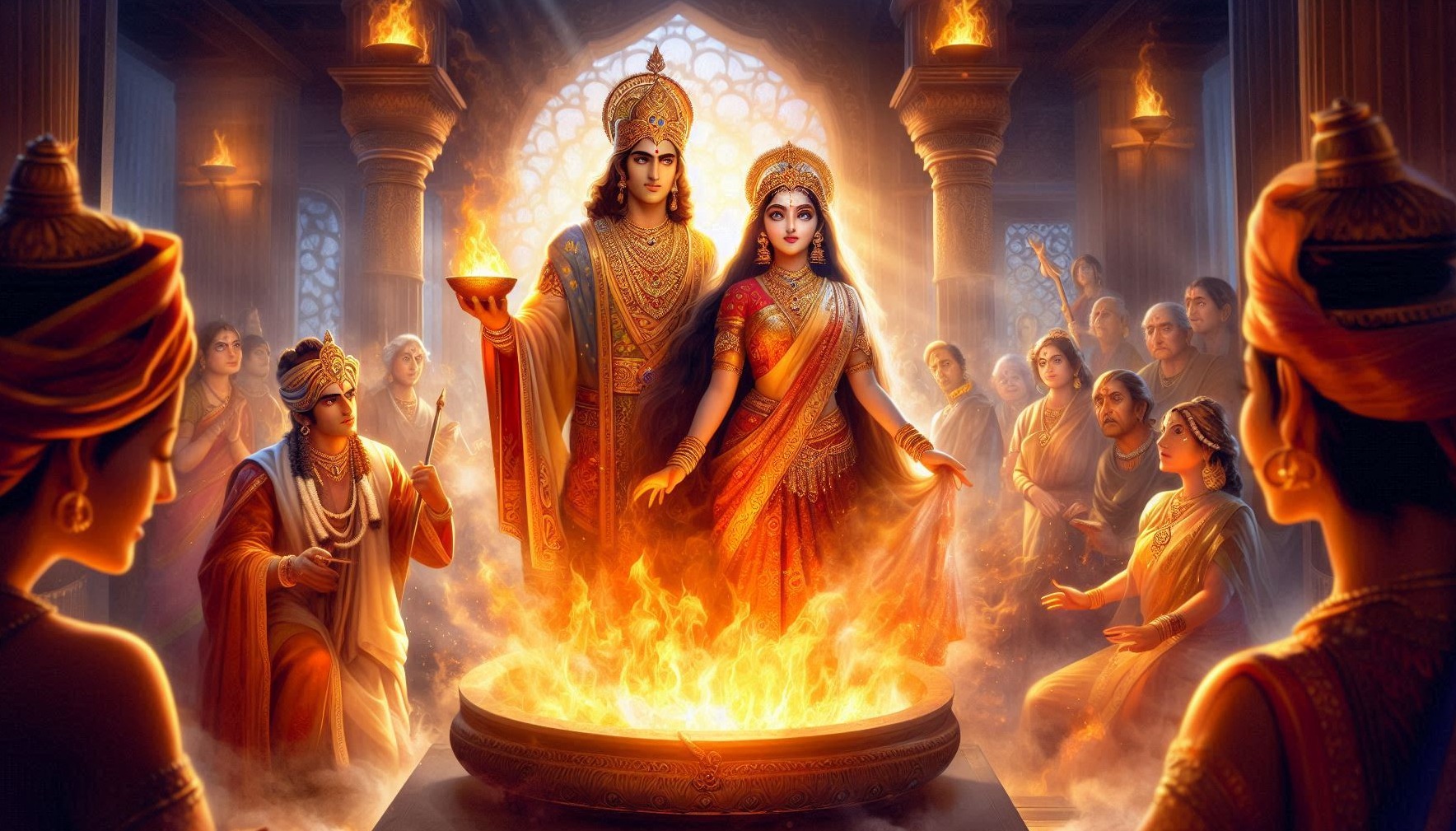
From this sacrificial fire, rises a child with a crown on his head and armor in his body and with a sword in hand. A voice was heard from the sky at that time, that this prince had been born to destroy Drona, and he shall dispel all fears of the people of the Panchala kingdom and spread their fame. Because he was born like a Dyumna (Power/splendor), he was named Dhrishtadyumna. Also from this sacrificial fire, rose a girl child, very beautiful and dark in complexion. Because of this she was named Krishna (the dark). She was also called Panchali, or Draupadi.
Drupada takes a vow from the Brahmans to keep the birth of the twins and their purpose as a secret. Later on, Dhrishtadyumna is sent to Drona for learning the art of using weapons. Drona relinquishes half the kingdom that he had taken from Drupada and teaches his sacrificial son the art of using weapons, who in the future, will be responsible for taking his guru Drona's life during the Kurukshetra war.
Mutual Destruction of Sunda and Upasunda
Though this story did not happen during the Mahabharata times, this story was narrated by Narada to the Pandavas after their marriage with Draupadi to help them create a system through which they will not quarrel among themselves for her, since she is their common wife.
In the race of Asura Hiranyakasipu, there was a daitya named Nikumbha. He had two sons Sunda and Upasunda. Both of them were mighty Asuras, with fierce and wicked hearts. They both had the same thoughts and did everything together. The ate together, fought together and even slept together. They never went anywhere without each other. They seemed to be one individual, divided into two parts. They both shared the same thoughts and performed the same feats. They grew up to be very notorious and dangerous. With the aim of ruling all three worlds, they performed severe penances in the Vindhya mountains. The celestials were alarmed about this. With an aim to disturb the penance of the brothers, they tried to create illusions of beautiful girls, showered them with various expensive gifts and also tried to create illusions in which there were women running in terror chased by Rakshasas. Nothing disturbed the brothers from focusing on their severe penance.
Moved by their penance, Lord Brahma appears before them - the brothers ask for a boon that will let them have the knowledge of all weapons, the powers of illusion, and the gift of immortality. Brahma grants them all except the immortality boon stating that the penance was conducted by the brothers for want of ruling the three worlds, so immortality could not be granted. The brothers then asked for a boon that they could only be slayed by each other, understanding that since they did everything together, killing each other would never occur. Brahma grants them the boon.
Armed with the power of the boon given unto them, the brothers set out to destroy the world. They traveled to the heaven - fearing their wrath, the celestials fled heaven and sought refuge with Lord Brahma. They then started slaughtering the Rishis and Sages who were performing sacred rituals. The Rishis and Sages, due to the powers they had obtained doing sacred rituals, made themselves invisible to the Asura brothers. But using illusion, the brothers found them and killed them. Sacrifices were stopped in earth, there were no festivals conducted, no ceremonies honoring the pitris were performed. The brothers thus ruled the earth from Kurukshetra without having a single rival.
The grief-stricken Rishis and Siddhas, then approached Brahma and sought his help to destroy the asura brothers. Lord Brahma, understanding the situation and taking a resolve to get rid of the brothers, summons the celestial architect, Viswakarman and commands him to create a beautiful woman, who could captivate all hearts. Viswakarman then carefully creates this unparalleled beauty, she is named Tilottama. Tilottama, as soon as she is given life, bows before Lord Brahma and asks about the purpose she has to fulfil. Brahma instructs her to tempt the Asura brothers with her captivating beauty in such a way, that in order to possess her, the brothers will quarrel and kill each other. Agreeing to that, Tilottama walks around the conclave where the Gods, Rishis and celestials are seated. Shocked by her beauty, Shiva rotates his face in 3 directions such that he could continue to see her, it was thus Shiva developed 4 heads. Lord Indra developed a thousand eyes all over his body, in order to keep watching her - such was her beauty.
In the meantime, the Asura brothers, fully intoxicated by drinking are enjoying their time in the Vindhya mountain range. Tilottama, clad in a single piece of red silk, approaches the asura brothers. Seeing her, both of them, out of lust, each grab her hands on each side. Intoxicated with all the riches and maddened with lust, they each claim her as their own. Soon, to establish superiority, they pick up their maces and fight against each other, killing each other instantaneously.
For fulfilling her task, Brahma grants a boon to Tilottama through which she gets to freely roam the region of the Adityas and that no-one will be able to look at her for an extended period of time, due to her beauty and splendor.
After listening to this story, narrated by Narada, the Pandavas come to an agreement that none of the other brothers should visit the other brother when he is with Draupadi. If they do breach this rule, that brother should retire themselves to the forest for 12 years, leading the life of a Brahmachari (renunciation of sex and marriage). Subsequently, Arjuna will be the first one to breach the rule, and will spend the next 12 years in the forest.
Pandavas birth on Earth is due to Indra's Arrogance
It is well known that the Pandavas were born to Kunti (Yudhishtir, Bhima and Arjuna) and Madri(Nakula and Sahadeva). There is some history to this beyond Kunti's boon from Durvasa for getting children through invoking celestials. The Pandavas are, in another way, incarnations of Lord Indra cursed to serve amongst the human beings by Shiva. This story will explain it in detail.
Long before the Mahabharata happened, there was once a grand sacrifice performed by the celestials in the forest of Naimisha. At that sacrifice, many celestials were present, including Indra, the God of Gods. Indra was sitting near the river Baghirati during this sacrifice, and noticed a golden lotus carried by the river current. Inquisitive, Indra follows the river up stream and sees a beautiful maiden in the river, crying. Her tear drops, when they were falling in to the river were becoming golden lotuses. Indra approaches her and asks her about her weeping. The maiden requests Indra to follow her if he wanted to find out the reason. Indra follows her.
Not far from there, Indra sees a handsome youth seated in a throne in the Himavat mountains playing dice with a young lady. Indra gets agitated because the youth does not pay any attention to him. Indra approaches him and claims that he is the lord of the universe. The youth continues to play dice and still does not pay any attention to Indra's claim. Indra gets angry and again quotes that he is the Lord of the Universe. The youth, who is none other than Shiva, continues to play the dice, smiles and glances at Indra. That glance paralyzes and freezes Indra. Once the game of dice is over, Shiva looks at the weeping woman and tells her to bring the frozen Indra to him, so that he may teach a lesson such that pride does not get to Indira's head again. As soon as the woman touches Indra, he comes back to life, but very weak and unable to stand, understands that the youth was none other than Mahadeva.
Shiva points to a cave covered by a rock, and asks Indra to remove the cover and enter the cave. Indra removes the stone and sees that there are 4 men standing inside. Shiva quotes that these are all forms of Indra and those were the times that Indira had behaved arrogantly in the past. Shiva also orders them to be born as human beings in the world, achieve many difficult feats and kill many thousand humans. It is only then that they will salvage their arrogance and become celestials again. The 4 men together agree to that, but request the gods of Dharma, Vayu, Meghavat and the twin Aswins to bear them as children to their would be mother. Born as human beings, together with the celestial powers, they will then be able to finish their task on earth and return back to Indra's abode. Indra, then instead of entering the cave as the fifth person, creates another self from within, and appoints that as the 5th person. Shiva agrees to this and also appoints Sri, as a common wife of these men. These 5 people are termed as Indras of "Old Order" and are named Vishwabuk, Bhutadhaman, Sivi of great energy, Santi the fourth, and Tejaswin the fifth.
Shiva along with these men, then approach lord Vishnu, who approves everything. Lord Vishnu, then takes up 2 hairs from his body, one white and the other black. These 2 strands of hair enters the womb of Devaki and Rohini of the Yadu race. One of the strands, the white one, becomes Valadeva, or Balarama as we know and the black hair strand is born as Krishna (Vishnu himself) to Devaki. It is thus described that the Pandavas were none other than five forms of Indira born in human form through the celestials to fulfill their tasks assigned by Mahadeva. And Sri, was born as Draupadi through a sacrificial fire to king Drupada to be married to the Pandavas.
There is no closure to what happens to the weeping woman, accompanied by Indra. Same is the case with her tears becoming golden lotuses in the Bhaghirati river. They remain incomplete in the narration.
Drona's Revenge on Drupada
The great sage Bharadwaja and the king of northern Panchala, Prishata, were very good friends. Bharadwaja had a son named Drona and Prishata had a son named Drupada. Both kids studied together under Bharadwaja and were very close friends in their childhood. During their friendship, Drupada tells Drona that he is his father's favorite and one day will be appointed king of the Panchala. When that happens, he would be ready to share his kingdom and his wealth with Drona.
Time flies, Prishata dies and Drupada ascends the throne and becomes the king of the northern Panchala. Drona continues to reside ih his father's hermitage and focus on learning the Vedas. Drona hears about Parasurama donating all his material possessions and approaches him. Based on Drona's request, Parasurama donates all him arms and the secrets invoking and retreating them to Drona along with the whole science of arms, the rules and their mysteries.
Years go by, and Drona marries Kripi and has a son named Aswatthama. One day, Aswatthama notices some rich kids drinking milk and starts crying for milk. Drona, being a poor Brahman, does not have a milch cow and feels bad for not being able to provide cow's milk for his son. Being a Brahman and having a resolve that he will never become a servant for anyone, he remembers his childhood friend Drupada and his promise to him and decides to visit him.
Drona visits Drupada at his kingdom and reminds Drupada of their childhood friendship. Hearing this, intoxicated with the wealth and being a king, Drupada humiliates Drona and says that a Brahman can never be equal to a king. He recognizes their childhood friendship as a friendship of equals when they were children and that now he is a king, and Drona a poor Brahman, he could only offer Drona one day of food and shelter. Drona is outraged by this and leaves Panchala to the Kuru kingdom, to acquire students that he could teach his skills, who, will subsequently help him teach Drupada a lesson.
One day, while Drona was staying in his wife Kripi's house, he comes across the princes of Hastinapur playing with a ball which falls into a well. In spite of many tries, they fail to retrieve the ball. Drona challenges them and throws his ring into the well. He says that he can not only bring the ball out, but also the ring. Drona, using his skills in the use of arms and some mantra, uses some blades of grass and retrieves the ball, followed by an arrow that brings up his ring from the bottom of the well. Seeing this, the Pandava princes are delighted and introduce him to Bhishma.
Drona meets Bhishma and conveys his intention on why he is in the Kuru kingdom. Bhishma agrees to make Drona the teacher of the princes of Hastinapur, who may, in future, help Drona achieve his objective.
Once the princes education was over, Drona asked them to beat the king Drupada of Panchala as his fees for teaching them. Promising to pay their guru his dakshina, the Hastinapur princes wage a war with the Panchala kingdom and subdue their mighty army (The Kauravas initially fail to win the war, later, the Pandavas engage and win the war) and offer Drupada to Drona as their fees.
Drona, once again, tries to revive his friendship with Drupada. Because Drupada had insulted him earlier since Drona was not equal to a king, he offers half of Drupada's kingdom (now that Drona owns the whole kingdom because he won the war) to Drupada and the rest he appoints himself the king, thus becoming equals and their friendship would be revived.
Thus half of the Panchala kingdom, the area to the north of the Bhagirathi river is ruled by Drona and the area to the south of the river is ruled by Drupada. Drupada agrees to Drona's proposal, but in his mind, resolves that he will relentlessly focus on ways to overcome Drona.
The Curse of King Parikshit
King Parikshit is son of Abhimanyu, and grand son of Arjuna. He was once hunting in a forest when he shoots an arrow and wounds a deer. The wounded deer disappears into the forest. Having never lost a deer, the king chases the deer into the forest. Filled with fatigue and thirst, he comes across a sage, Samika. Samika is in a deep penance and had taken a vow of silence. He introduces himself as the King and asks the sage if he had seen a deer. The sage, due to his vow of silence, did not reply one word, good or bad. Becoming angry, the king then sees a dead snake nearby and takes it up with the end of his bow and places on the neck of the sage.
The sage does not protest. Having done a bad deed, the king feels sorry for his act, but leaves the place and returns back to his capital. Samika remains true to his duty, and does not curse the king for his act. Rishi Samika has a son, names Sringin. As Sringin was walking home, he meets another Rishi's son named Krisa. Krisa makes fun of Sringin and narrates him the incident of the king placing a dead snake on his father. Sringin, understands from Krisa why that happened and immediately places a curse on the king as follows:
"'That sinful wretch of a monarch who hath placed a dead snake on the shoulders of my lean and old parent, that insulter of Brahmanas and tarnisher of the fame of the Kurus, shall be taken within seven nights hence to the regions of Yama (Death) by the snake Takshaka, the powerful king of serpents, stimulated thereto by the strength of my words!'".
He then reaches home and tells his father about the curse he had place on the king. Samika immediately pacifies him, and explains to him that Ascetics like them should not place curses on kings, since Parikshit has been a righteous king and righteous kings leads to prosperity and that Parikshit did not deserve this curse, and that he did this act due to the ignorance of the fact that the Rishi was in a vow of silence. Since curses placed cannot be taken back, the Rishi Samika then decides to let the king know of the curse. He sends one of his disciples, Gaurmukha, to inform the king of the curse. Gaurmukha reaches the palace and meets the king. He narrates the curse - listening to that, Parikshit feels deeply sorry for his act.
After Gaurmukha leaves the palace, without losing time, Parikshit immediately consults with his ministers. He then builds a mansion erected upon a solitary column. It was well-guarded day and night. And to protect it, there were physicians and medicines, and Brahmanas skilled in mantras all around. The king, protected on all sides, discharged his kingly duties from that place surrounded by his virtuous ministers. And no one could approach the king in that mansion. The air even could not go there, being prevented from entering.
When the 7th day arrived, the wise brahmana, Kasyapa was summoned to the mansion. Kasyapa had been granted with a boon from Brahma to have the ability to cure any snake's poisonous bite. He had heard all about the king's curse that Takshaka, king of serpents, will cause his death. He was determined to stop that so that he could be well rewarded. On his way, he meets an old Brahmana (Takshaka in disguise) who asks him where he was heading towards. Kasyapa narrates the objective to him. Takshaka tells Kasyapa about his true identity and challenges his poison curing skills. Kasyapa agrees to the challenge. Takshaka poisons a nearby banyan tree, which immediately burns due to the power of the poison and reduces to ashes. Kasyapa, takes those ashes in his hand and creates the tree back to its full form, by creating a sprout, 2 leaves, stem and then the branches. Observing Kasyapa's ability to neutralize his poison, Takshaka offers more wealth than what Kasyapa would get from the king for saving his life. Kasyapa, immediately meditates and with his power, learns that the king had really run out of his life. He then accepts the wealth from Takshaka and leaves.
Takshaka then devises a plan to enter the mansion. He sends a few snakes in the guise of ascetics with fruits, kusa, grass and water to the king. The king, receives them and accepts the gifts. After the snakes (disguised as ascetics) leave, the king then requests his ministers to share the gifts from the ascetics. Parikshit, takes a fruit and while he was eating, there appeared an ugly insect from the fruit, of black eyes and of coppery color. The king, knowing that his time has come, says the following:
"'The sun is setting; today I have no more fear from poison. Therefore, let this insect become Takshaka and bite me, so that my sinful act may be expiated and the words of the ascetic rendered true".
Saying that, he places that insect on his neck and smiles, knowing his hour had come. Takshaka immediately coils around the king's neck and bites him to his death. It is said that the powerful poison from Takshaka blazed up the whole mansion. After performing his last rites, the people of the kingdom appoint Parikshit's minor son, Janamejaya, as their king.
Long after, at the behest of Sage Uttanka, king Janamejaya takes revenge for his father's death, performs the snake sacrifice to exterminate the race of serpents. It is during this sacrifice the Mahabharata is recited by Vaisampayana, at the request of Dwaipayana Vyasa when Janamejaya requests to know about his ancestors.
Agni's desire to burn Khandava Forest
King Swetaki is a very religious and just king. No one on earth equalled him on sacrifices, charity and intelligence. He was set upon performing sacrifices that are of great length, some of them continuing for decades. The Brahmanas involved in helping him perform these sacrifices grew tired of the smoke and the length of these sacrifices. They slowly started to refuse to entertain any more sacirificial request from the King. When confronted, the Brahmanas told the king that they are physically unable to support his sacrificial requests and ask him to reach out to Lord Shiva to help him complete the sacrifices. Swetaki then reaches mount Kailasa and engages in severe penance to get the attention of Shiva. Shiva, moved by the king's effort, appears before him and asks him to first perform a continuous sacrifice in whch the king has to pour clarified butter into the sacrificial fire continuously for a period of 12 years. Swetaki completes this task without a hitch and requests Shiva again for help. Shiva, pleased with Swetaki's acts, asks him to engage the great sage Dhurvasa for performing his sacrifices. Sage Dhurvasa, at the command of Lord Shiva, assists king Swetaki in his sacrifices.
In the meantime, Agni, saturated by drinking clarified butter for 12 years continuously becomes pale, weak and ill. Agni loses his splendor and vigor - so he approaches Lord Brahma and seeks his help. Lord Brahma requests Agni to consume the Khandava forest with all living beings in it. He says that the animal's fat when consumed by Agni will help Agni regain his power and splendor. This is the reason why Agni wants to burn the forest. But everytime Agni tries to burn the forest, Varuna, the god of rain tries to stop it. The great snake king, Takshaka lives in Khandava and is a good friend of Varuna. Hence Varuna stops Agni's repeated effort to burn the forest. Thus unable to consume the forest with all living beings included, Agni requests the support of Arjuna and Krishna to help him consume the forest.
Veda Vyasa's Story
King Uparichara (also called Vasu) of the Chedi kingdom, gets a twin babies from the river Suktimati in exchange for releasing the river from the clutches of the mountain Kolahala. He makes the boy commander of his army and marries the girl Girika. Once Vasu is requested by his Pitris to hunt for deer as an offering for performing Srardha. He, remembering his wife Girika in the forest while hunting, out of lust, requests a hawk to carry his "seed" to his wife. The hawk in flight, fights with another hawk and in the process, drops the seed onto river Yamuna. In the river, there was a fish (once an apsara named Adrika, cursed by a Brahmana to live as a fish) who swallows the seed. This fish is subsequently caught by fishermen (after 10 months) who were surprised to find a male and female child in the fish's womb. They approach their king Uparichara and the king takes the male child who becomes king Matsya later on. The king asks the fisherman to consider the "fish smelling" female child to be his own. The fisherman accepts the child and names her Satyavati.
Satyavati grows to help her father ply boats in river Yamuna. One day, Sage Parasara crosses the river Yamuna on her boat and wowed by the beauty of Satyavati, proposes to have a union with her. Satyavati is reluctant at first, but gets 2 boons granted by the sage in return for the union: that she will remain a virgin even after their union and that her body emit a sweet scent (instead of the fishy smell). Because of this boon, Satyavati is also called Yojanagandha(who scatters her smell a yojana all around), and also Gandhavati(sweet scented one). They then have their union in an island on the Yamuna.
Because of the union with sage Parasara, Satyavati gives birth to Dwaipayana (Dwaipa means island born). It is said that Dwaipayana developed his body through his will as soon as he was born. Dwaipayana leaves the island to focus on asceticism letting Satyavati (his mother) know that he will appear whenever she remembers him. Dwaipayana later arranged the Vedas into 4 groups that we know today because of which he came to be called as Vyasa (Compiler or Arranger). He also composed the Mahabharata (initially called Bharata).
Later on, Satyavati is married to King Shantanu and gives birth to two children Chitrangadha and Vichitravirya. Vichitravirya is married to Ambika and Ambalika, but dies without producing any off-spring. Satyavati then asks Bhishma (Shantanu's son through Ganga) to father the widows(Ambika and Ambalika) children for the purpose of extending their race. Since Bhishma had taken a vow of celibacy, he respectfully refuses. Satyavati then summons her other son, Vyasa (Son of Satyavati and Parasara) to give them children. Vyasa agrees to this, and thus fathers Dhritarashtra through Ambika and Pandu through Ambalika.
When Vyasa meets with Ambika, she closes her eyes since she feared seeing the dark face, matted locks, strong odor, blazing eyes and his grim beard - because of this, Vyasa tells Satyavati that Ambika's child will be born a powerful king, but blind. When Vyasa meets with Ambalika, at the sight of Vyasa, Ambalika turns pale with fear. Vyasa then tells her that her child will also be pale and will be called Pandu(the pale).
Satyavati, not satisfied with the 2 unions and their results, asks Ambika to meet with Vyasa again - fearing to meet him, Ambika sends a beautiful maid servant who pleasantly attends to Vyasa. Vyasa blesses her with a son and releases her from being a slave. This maid servant gives birth to Vidura.
Viswamitra - from a powerful king to a sage
Once King Viswamitra reaches the hermitage of sage Vasishta with his army. The sage takes care of Viswamitra by providing him water, food, wild fruits and clarified butter. The king notices that the sage has a cow named Nandini that could provide him with anything he wants in unlimited quantity. Looking at this cow, the king wishes to possess it and offers 10,000 kine or his whole kingdom. Vasishta rejects the offer saying that the cow is there for the sage to take care of gods, guests and pitris and for his sacrifices.
Viswamitra threatens to take the cow by force and tries to drag the cow out of the Ashram. Nandini cries and appeals to Vasishta to help. Vasishta politely denies saying that he is a forgiving Brahmana and cannot fight against the might of a king. Nandini then gets angry at the king and brings up armies from various parts of her body to fight the king's armies. Overwhelmed by the armies created by Nandini, King Viswamitra's troops fled in all directions. The king sees this and realizes that physical power as a king doesnt yield real power and real power comes only from ascetic penances and so decides to become a sage.

Mobirise