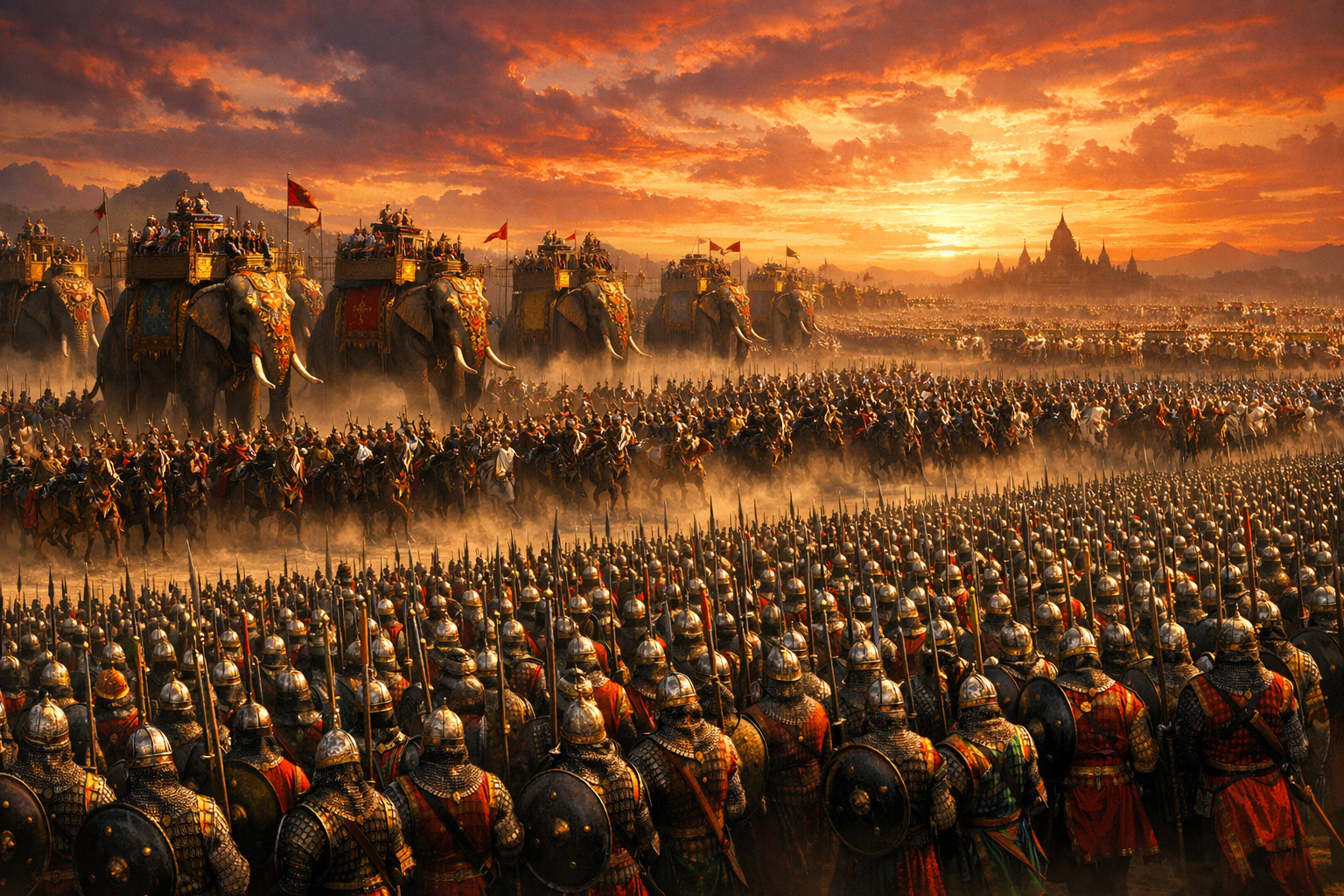
Graphical Representation of One Akshauhini
Akshauhini
Akshauhini is the measure of military unit used in the Mahabharata.To understand the magnitude of war of the Mahabharata, one needs to understand the no. of soldiers, horses, elephants and chariots used from both sides. The calculations are mind-numbing. Here is what the original version says as described by Sauti to a group of great sages. Sauti is the surname of Ugrasrava, who had attended the great snake sacrifice of Janamejaya, in which the story of Mahabharata was recited in full by Vaisampayana, as directed by Vyasa himself, who composed this holy composition named Mahabharata. The lowest measure in army terms used was a "Patti" - which included One chariot, one elephant, five foot-soldiers, and three horses. The different units and their conversions are as follows:As per the above conversion(s), one Akshauhini equals
Chariots 21,870
Elephants 21,870
Foot-soldiers 109,350
Horses 65,610
There were 18 Akshauhini used in the war from both sides: As per these calculations, here is the numbers for those who don't have a calculator ready:
Chariots 393,660
Elephants 393,660
Foot Soldiers 1,968,300
Horses 1,180,980
For comparison purposes, the US had around 1.5 million people on active military duty in 2010 - that is including Army, Marine Corps, Navy, Air force and coast guard, as per Wikipedia..!!
Graphical Representation of One Akshauhini
Atiratha
Atiratha is the name for a car-warrior (chariot) capable of fighting at one time, with sixty thousand foes. Arjuna has been quoted as an Atiratha. Bhishma and Drona are also termed as Atirathas in the Mahabharata. In Krishna's Yadava Dynasty, the Mahabharata quotes the names of seven people who are considered Atirathas: Ahuka, Charudeshna, his brother Chakradeva, Satyaki, Valadeva, Krishna himself, and his son Samva.
Bharata
The original name of the epic, named after the story of the Bharata dynasty - was renamed to Mahabharata due to its content that was more richer than the 4 vedas put together.
Brahmasira
Name of the weapon given by Drona to Arjuna and the methods for hurling and recalling it. The weapon is so powerful, that if it used against an inferior human foe, it might burn the whole world.
Chakshushi
The science of Illusion. Usually practiced by Gandharvas. This science, was created by Manu, passed on to Soma and then on to Viswavasu. The gandharva Angaraparana learns this science from Viswavasu. In the duel that happens between Arjuna and Angaraparana (refer Dhaumya for more details), the gandharva explains about this science to Arjuna. When Arjuna wins the duel, Angaraparana offers this science to Arjuna, as a gift for victory. Arjuna politely declines, but instead offers to exchange the Gandharva's horses for his own weapon of fire.
Kshatriyas
The warrior class within the 4 classes of society. Kings belonged to the Kshatriya class. Each class has their dharma, or rules established. It is considered that people should follow the dharma as prescribed for their class diligently. Any and all deviations are considered as sins.
Kuru
Name of the race - Both Pandavas and Kauravas belonged to this race.
Mahabharata
The Mahabharata, as we know it today, was originally called Bharata, relating to the story of the kingdom Bharata, ruled by Emperor Bharata, ancestor of the Kuru clan. One day, a group of celestials assembled together to judge the importance of substance of this composition. They used a balance to compare the four vedas and the Bharata. The latter weighed more than the four vedas combined. From that day forward, Bharata was called Mahabharata, meaning the great Bharata. The original version composed by Vyasa had 8800 verses and was named as "Jaya", referring to the first verse of the epic. Vaisampayana added to this original version taking it to a total of 24,000 verses and called it "Bharatasamhita". Suta made many more additions making it the "Mahabharata". The current version of the epic consists of 100,000 verses. It is said to have taken centuries to take the book from "Jaya" to "Mahabharata".
Mahadivya
Mighty Egg - foremost of all beings - The Mahabharata quotes that it is from this Mahadivya that Lord Brahma emerged along with Suraguru and Stanu - the 3 prime foremost of all beings on earth.

1. There were a total of 102 off springs for Dhritarashtra.
2. The table lists the names in order of their birth - It has to be read top-down and left-right.
3. * Yuyutsu, was Dhritarashtra’s son born to a Vysya woman and not to Gandhari.
4. # Duhshala, was the only girl child over and above the 100 brothers.
One Woman to One Man Concept
Once upon a time, women were freely roaming the earth. They were not confined to their husbands, bound to their homes and not dependent on their husbands or relatives. They roamed freely and enjoyed themselves as best as they liked. They did not attend to their husbands faithfully, yet were not considered sinful since it was the practice in that era. To this day that is the practice followed by all living beings except humans. The human concept of one wife confined to one husband was created by the great rishi Uddalaka's son Swetaketu out of anger. Once a brahmana was visiting Uddalaka and in the course of conversation, held his wife's hand. Seeing this, their son Swetaketu got angered and disapproved of that usage and made it a rule for humans to be followed. Since then, the concept of one man to one woman began - anything else was considered sinful. Pandu explains ths to his wife Kunti in Sambava parva.
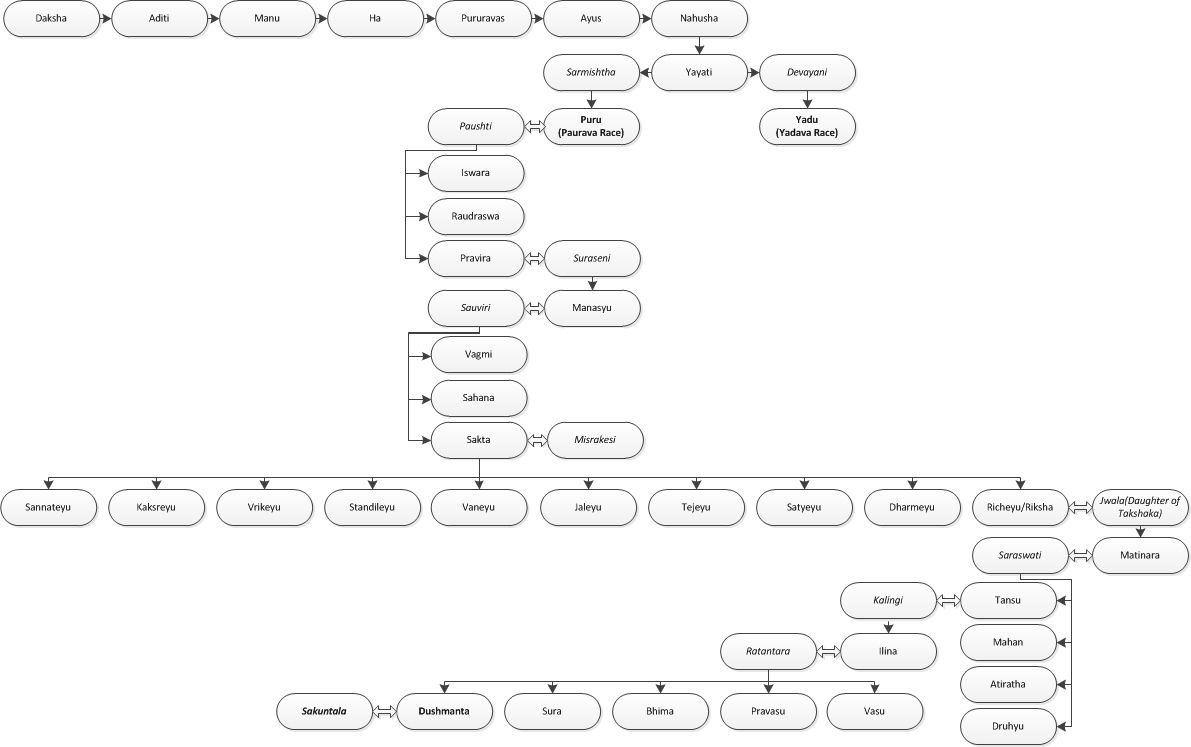
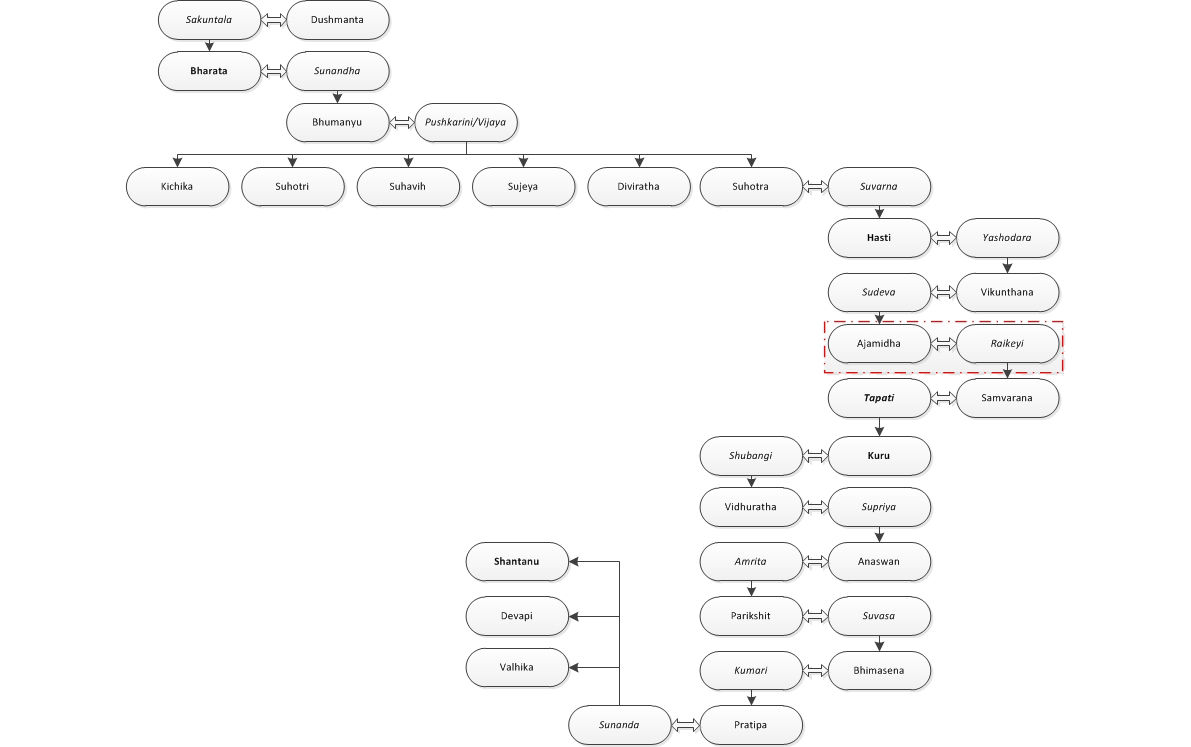
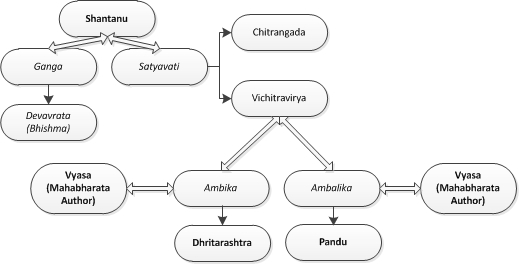
Hierarchy Chart 03 (continued from previous)
Ramayana
One of the two great epics (Itihasas) of the Hindu Religion - The Ramayana is recited within the Mahabharata in Aranyaka Parva. Markandeya recites the Ramayana to Yudhishtira when requested by him. Ramayana happened much earlier than Mahabharata - Hanuman, a key character in the Ramayana has some altercations with Bhima (both of them born to Vayu, the Wind God). Hanuman also features in the flag of Arjuna’s chariot during the Kurukshetra war.
Samantha Panchaka
In the interval between the Treta and Dwapara Yugas, Rama (the son of Jamadagni) also called Parashurama, urged by impatience of wrongs done to him, repeatedly (21 times over) killed the noble race of Kshatriyas. He, by his own valor, annihilated the entire tribe of the Kshatriyas and formed at Samanta panchaka five lakes of blood. We are told that his reason being overpowered by anger he offered oblations of blood to the manes of his ancestors, standing in the midst of those lakes.
It was then that his forefathers of whom Richika was the first having arrived there give him a boon as return for the gratification. Parashurama asks him to absolve his from the sins arising out of his annihilation of the kshatriyas out of anger and to make the lakes famous in the world as holy shrines. He was granted his boon and got pacified. The region that lied near those lakes of gory water, from that time has been celebrated as Samanta panchaka the holy.
As per the Mahabharata, the Kurukshetra war was fought in this region.
Sahadeva
One of the five Pandava brothers and one of the twin sons of Madri, the other one is Nakula. Sahadeva knows the future but cannot divulge the future to anyone. As per the Mahabharata, Sahadeva knew everything that would happen, including the war and the result of the war.
Sakuni
Brother of Gandhari, Dhritarashtra's wife and Kaurava's uncle. He is depicted as a cunning person and has been portrayed as a key individual responsible for the war. He is killed by Sahadeva on the 18th day of the war.
Yuga
Yuga defines a period in time. In the Mahabharata, Markandeya explains the concept of Yuga to Yudishtir in detail. As per this explanation, there are four Yugas in the following order: Krita Yuga, Treta Yuga, Dwapara Yuga and Kali Yuga. These Yugas together last 12,000 years (Please refer to the individual Yugas for the no. of years each represent). Yugas repeat themselves, meaning, after the four yugas complete, the world gets into a universal destruction completing 1 cycle and everything gets recreated again, starting with the Krita Yuga. A 1000 of these cycles represent Brahma, the creator's 1 day. The years represented are divine years, meaning 1 divine year equals 360 human years approximately. During each Yuga, towards the end of that Yuga, things deteriorate from how they begin - for example, falsehood rises, people do not perform duties prescribed for their order and so on. Markandeya goes on to describe the whats, whos and the hows of deterioration at a great extent - many of which is not going to be added here, but in general, the concept is that the Yugas start with a clean, pure state and as it progresses, moves towards a deteriorated state.
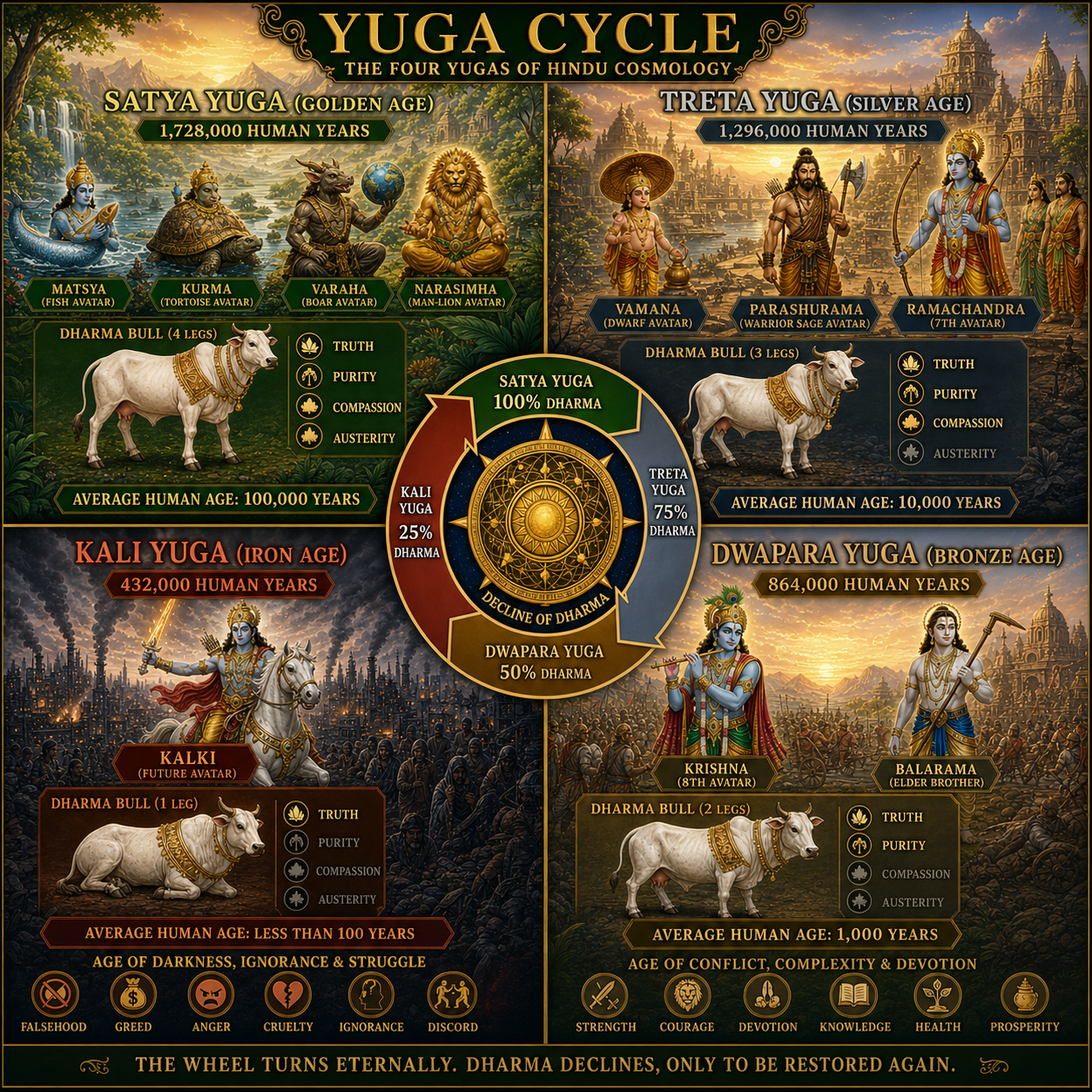
The Cycle of the 4 Yugas
Yuga - Krita
Also called as the Satya Yuga. This is considered as the age of the truth. The first of the four yugas. There were 4 avatars of Vishnu in this Yuga- namely, Matsya, Kurma, Varaha and Narasimha. This Yuga lasted for 4800 divine years (1 divine year = 360 human years). Human height was believed to be 21 cubits (31.5 Feet).
Yuga - Treta
Second of the four Yugas. This Yuga lasted for 3600 divine years (1 divine year = 360 human years). The beginning and end of this Yuga each lasted 300 years, meaning, the cusp of the previous yuga, Krita Yuga and Treta Yuga lasted 300 years and the cusp of Treta and Dwapara Yuga lasted 300 years, adding to a total of 3,600 divine years. Vishnu had 3 avatars in this Yuga - Vamana, Parashurama and Ramachandra.
Yuga - Dwapara
The third of the four yugas, after Treta and before Kali yuga. Dwapara Yuga lasts for 2,400 divine years ( 1 divine year = 360 human years). Average lifespan was 200 years. Human height is believed to be 7 cubits (10+ feet, 1 cubit is considered to be 18 inches). Vishnu's avatars were Krishna and Balarama/Buddha.
Yuga - Kali
The last of the 4 yugas, the other 3 being Satya, Treta and Dwapara in that sequence. Kali yuga started around the death of Krishna (circa 3102 BC) and is expected to last 1200 divine years. We are currently expected to be approximately 5000 years into it. Average lifespan is 90 to 100 years. Human height is believed to be 3.5 cubits. (Please note that some external references have been taken). At the end of this Yuga, everything is destructed and the four Yugas repeat again.

Drag & Drop Website Builder